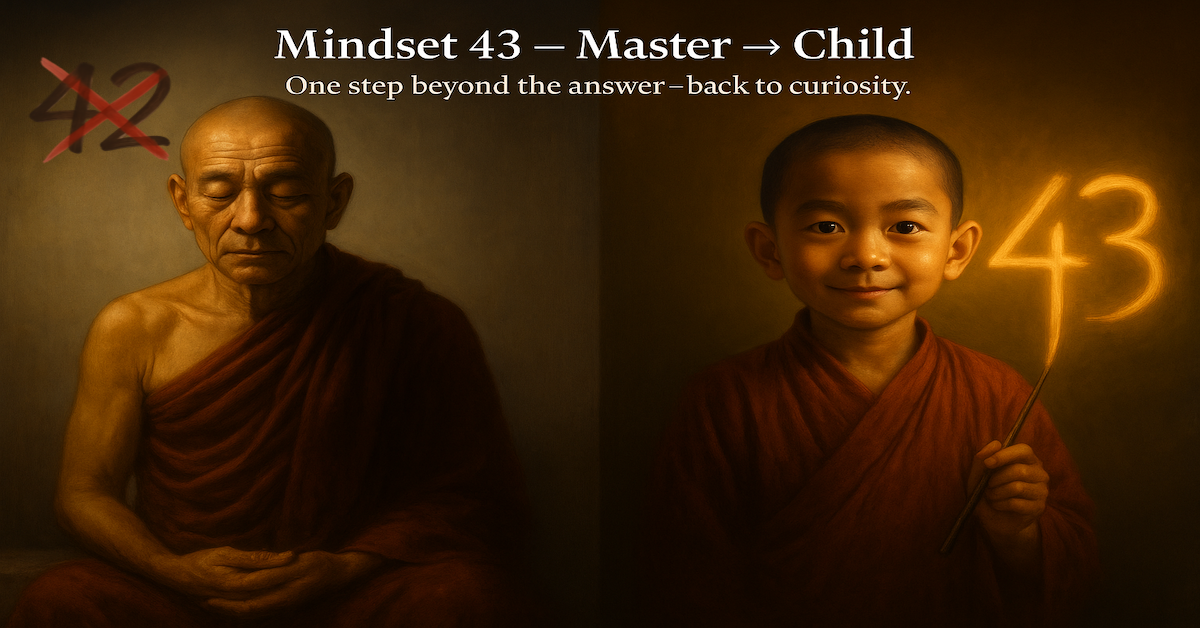
Mindset 43
Mindset 43 is what you get when you take the Ultimate answer 42 and turn it up to 11.
43 – One Step Beyond the Ultimate Answer a 10X Mindset.
Mindset 43 names the step after mastery—the shift from pride in what we know to wonder at what we’ve yet to learn. It is the childlike curiosity that follows expertise, the stance that keeps us humble, hungry, and open to discovery.
To myself I am only a child playing on the beach, while vast oceans of truth lie undiscovered before me.
Isaac Newton – Principia Mathematica.
(Invented calculus, Unified the universe through gravity, Established modern physics, Pioneered optics, …)
The Story We’re Building From (42 → 43)
In The Hitchhiker’s Guide to the Galaxy, the supercomputer Deep Thought calculates the Ultimate Answer to Life, the Universe, and Everything—42—but explains that the Question is unknown and requires a new computer (Earth) to discover it. Mindset 43 extends that parable: beyond the celebrated “answer” lies a wiser posture—returning to curiosity. 43 is our shorthand for that step: one beyond the ultimate answer, into intentional not‑knowing.
Why 43: From Master → Child
Mastery matters, but it is not the summit. The moment after we “arrive” is when we can begin again—eyes fresh, assumptions loosened, willing to be surprised. 43 invites us to treat each achievement as a new trailhead. It replaces the fear of not knowing with the joy of learning, and it treats every “final” answer as a provisional draft.
The Mountains Beyond the Mountain

Reaching the summit of any mountain feels like an ending — the long climb, the final push, the satisfaction of standing where few have stood. Yet every peak, once reached, reveals an entire horizon of higher ridges still waiting. Mastery works the same way. What looks like arrival is actually the trailhead for something larger. At the moment we stand tallest, vision clears: we see not only the ground we’ve covered, but also the vast expanse we have yet to explore. Mindset 43 is this posture — the humility to treat each summit as a beginning, the curiosity to welcome new climbs, and the courage to see every “final” answer as just one more vantage point toward the undiscovered.
A Physics Lesson in Humility
Taught historically, physics shows how useful theories eventually meet edge‑cases. Each exception invites a better approximation; each new model becomes provisional in turn. We learn to expect revision, to welcome anomalies as guides. 43 is this scientific humility in daily life: assume your current map is the best so far—and be ready to redraw it.
Beginner’s Mind (Shoshin)

In Zen, shoshin—beginner’s mind—is the discipline of meeting the familiar as if for the first time. It counters expert blindness, invites many possibilities, and keeps learning elastic. 43 stands beside shoshin: both honor freshness over certainty and curiosity over conclusion.
Emptying the Cup (Zen & Thich Nhat Hanh)
A classic Zen parable tells of an overfull cup: while it’s full, nothing more can be poured. Thich Nhat Hanh often taught the practice of emptying—releasing preconceptions so perception can be fresh. 43 adopts the same move: set down yesterday’s certainties so today can teach you.
Why “Turn It Up to 11”?
In pop culture, “turn it up to eleven” comes from the 1984 mockumentary This Is Spinal Tap, where guitarist Nigel Tufnel proudly shows an amplifier whose volume knobs go to 11—“one louder” than the usual maximum. The phrase has come to mean pushing beyond conventional limits. We use it here both playfully and precisely: 43 is “one beyond 42,” the step after the Ultimate Answer—signaling the move from certainty into renewed curiosity.
Other Echoes Across Traditions
Socratic Wisdom: Knowing that we do not know is the beginning of wisdom. Taoist Humility: The way flows; rigidity breaks. Stay soft enough to learn. Scientific Method: Treat beliefs as hypotheses. Test, observe, revise. Creative Practice: Iterate toward truth; let drafts teach you what the final cannot.
42 as Death, 43 as Rebirth

In Japanese culture, the number 42 is often associated with death, as its pronunciation “shi-ni” echoes the phrase to die. Death, however, is not viewed solely as an end. It is also a passage — a liminal space that precedes renewal. Within this lens, 42 marks the culmination, the closing of a cycle, the finality of mastery. Yet what follows is not emptiness but transformation. 43 emerges as the birth that follows death, the childlike wonder that arises once pride in knowing dissolves. To step into 43 is to embrace the humility of beginnings after the finality of endings — to recognize that every peak reveals new mountains, every death opens into a larger life.
Cultural Reflection: Evangelion — Death & Rebirth (1997)

In Japanese storytelling, endings are often preludes. Neon Genesis Evangelion: Death & Rebirth (1997) splits the arc into two halves: Death as deconstruction and Rebirth as transformation. That’s the spirit of 43: what looks like the end of mastery is the beginning of something larger, entered with fresh eyes and a child’s curiosity.
Evangelion reminds us that endings rarely resolve as neatly as we hope. “Death” in the film is not annihilation but a stripping away—a dismantling of certainty, identity, and even narrative form. In the same way, the mastery we achieve at 42 eventually collapses under its own weight. Certainty becomes limiting; closure becomes confinement. The lesson of 43 is that we must let go of the structures that carried us this far so that new forms of knowing can emerge.
“Rebirth” in Evangelion does not return us to where we began; it delivers us into unfamiliar ground. Characters awaken not to the comfort of restored order but to a wider, more ambiguous possibility. This is precisely the invitation of 43: to cross through the death of finality into the unsettling but liberating expanse of not-knowing. What feels like dissolution is, in fact, the creation of space for wonder—an opening into the endless oceans Newton glimpsed from the shore.
Practices for Living 43 (Self)
Empty‑Cup Rituals: Before key work, ask: What might I be assuming? What can I set down? Breathe, name two assumptions, and choose one to test. Don’t‑Know Posture: Replace statements with questions for one meeting a day. Notice how the room changes. Micro‑Experiments: Turn debates into trials. Define a smallest honest test; ship it; learn. Re‑Credentialing: Regularly apprentice yourself to something new—tool, domain, or perspective—to keep your learning muscles supple. Gratitude for Correction: Thank people who disconfirm you. Track what changed because of their input.
Practices for Leaders & Teams
Normalize Not‑Knowing: Model it: “Here’s what we think; here’s what we don’t know; here’s how we’ll learn.” Gift‑Framed Candor: Offer feedback as help, with clear intent and one actionable next step. Rotate the Mic: Share facilitation, demo leads, and decision summaries so leadership circulates. Learning Harvests: Close projects with short rituals: What surprised us? What will we change? Edge‑of‑Chaos Guardrails: Name boundaries (time, risk, quality) and freedoms (approach, tools) so exploration stays coherent.
Recognizing & Hiring for 43
Signals: Uses “we/us,” invites dissent, turns critique into experiments, names what they learned not just what they did. Interview Prompts: “Tell me about a time you were sure and then changed your mind—what caused the shift?” “Describe a smallest‑honest experiment you ran to resolve uncertainty.” Live: “Coach me to improve this rough draft in 8 minutes.” (Look for curiosity, gift‑framed candor, and co‑creation.)
Why 43 Belongs on 10X Mindsets
10X growth demands more than answers; it demands renewable curiosity. 43 keeps us from calcifying after wins, invites us back to wonder, and turns continuous learning into a way of being—so our impact compounds for good.
See Also
- 10X Mindsets
A portfolio of teachable mindsets—resilience, edge-of-chaos, gifts, leadership, confidence. - Beginner’s Mind (Shoshin)
Overview: A concise explanation of the Zen discipline of meeting each moment with fresh eyes and few preconceptions. - Thich Nhat Hanh
Emptying to See Anew: Teachings on releasing fixed views so perception becomes fresh and compassionate. - Everything a Gift
Atomic Rituals: Reframing disruption as fuel; how giving and receiving as gifts transforms growth. - The Edge of Chaos
Atomic Rituals: Designing just‑enough order for exploration so learning stays fast and coherent. - Journey
Human Transformation: Why accelerating digital change makes human transformation a necessity, not a luxury. - Learned Resilience
Talent Whisperers: Resilience as a cultivated skill—beyond grit, beyond bounce‑back—to learning and integration.